IT and security resilience for containerized workloads
Always available. Ransom immune. Half the storage cost.
Every Kubernetes recovery plan assumes something survives: a backup bucket, a replica, a second region. Those are infrastructure too. When the infrastructure fails or is attacked, the resilience goes with it.
Myota provides IT and security resilience in one step, at write: the data, the keys and the metadata are each sharded and spread across independent locations. An attacker who reaches a location finds nothing whole to steal, encrypt or destroy. A failure takes nothing with it: the engine in your cluster holds no data, so recovery moves none.
Confidentiality, integrity and availability are intrinsic to the data. Assume they get in: a stolen storage credential or a breached bucket yields no complete file, no usable key and no map.
Every write your app makes to Myota is a restore point, so your RPO is the last write. A bad deploy or a mass delete goes back to the second before with no restore to run, at a 100% recovery success rate.
Resiliency without redundancy. Compared with 3-2-1 data replication strategies, one sharded footprint spans your locations and survives losing one. Every full copy beyond it no longer has a job: on average, half your storage cost.
Your app writes to Myota over an S3 compatible API, so nothing changes in front of it. Encryption, sharding and placement run inline, and nothing runs on the storage. Think RAID across locations, with every piece encrypted first. Reads pull shards in parallel from the fastest locations.
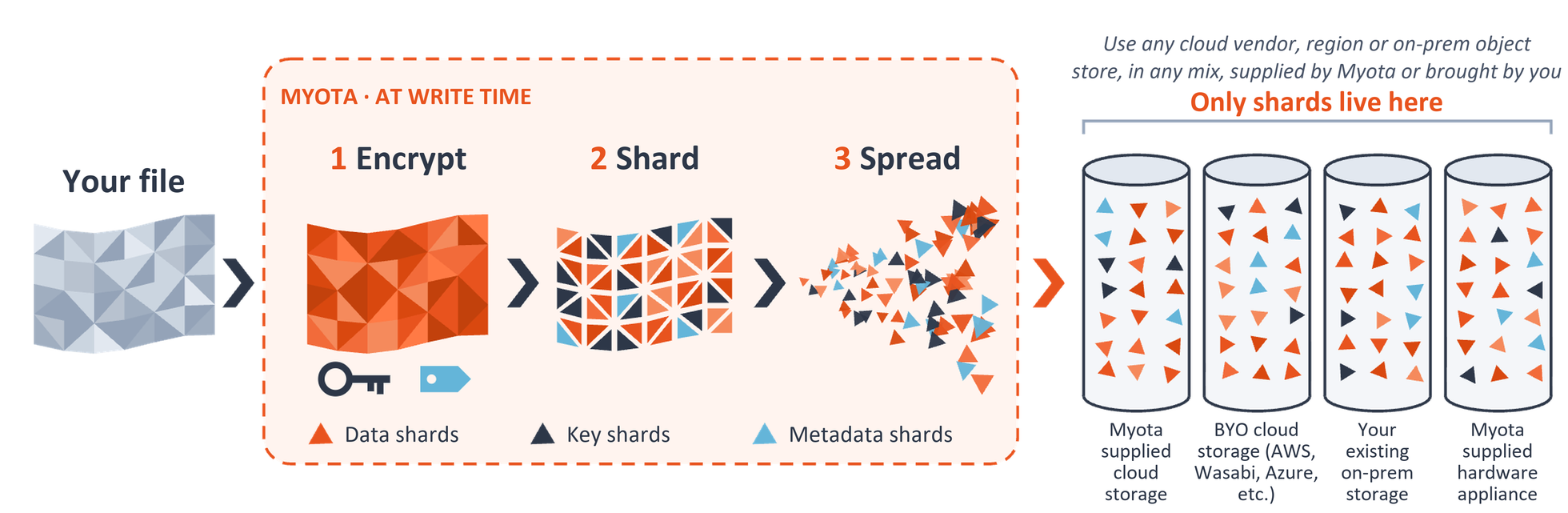
Zero trust, down to the data. Kubernetes assumes breach, yet the storage underneath still trusts a provider, a key service and a region. With Myota, no location holds a complete file, a usable key or the map, so no location or provider has to be trusted.
Transparent to applications and users, and essentially flat against direct.
Matches direct AWS S3, at the same speed as without Myota.
80% faster than direct, sequential, hundreds to thousands of objects.
Your app writes to Myota. So does everything your cluster needs to come back: cluster state, database state and infrastructure state go to the same S3 endpoint with the same protection. Lose the cluster, the region or the engine, and only the compute gets rebuilt.
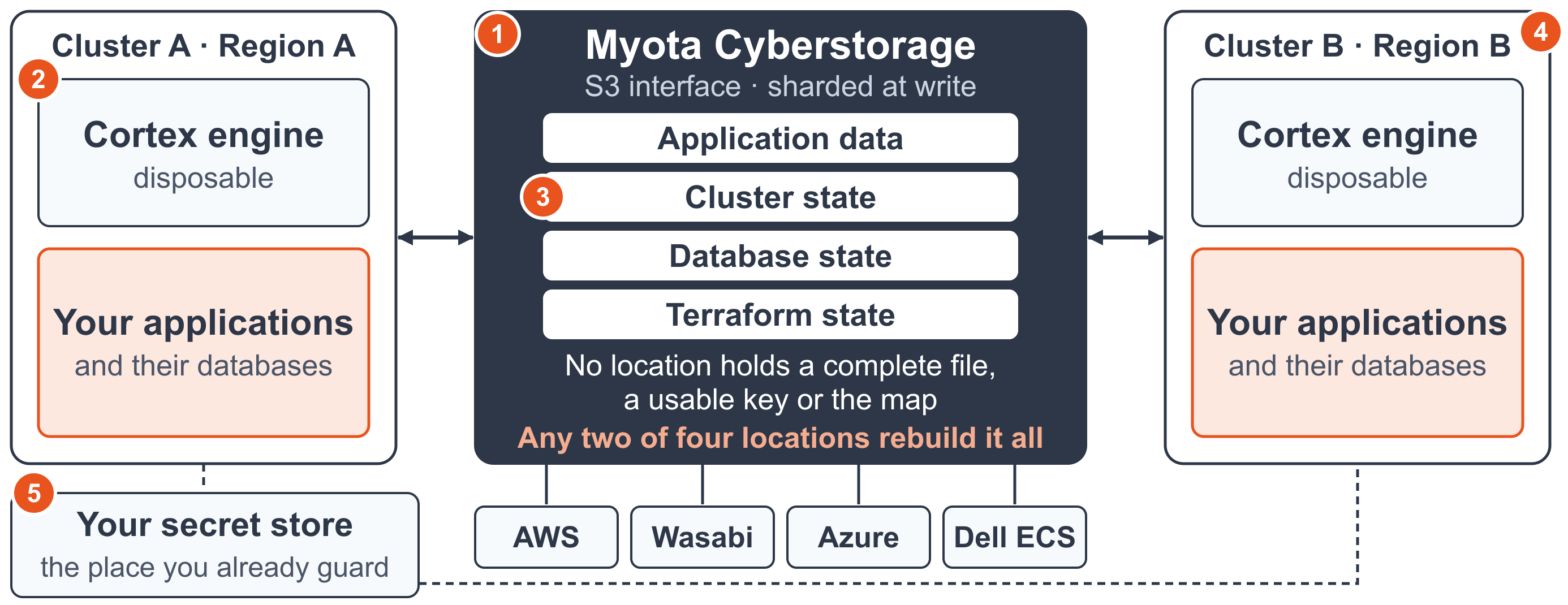
Reference architecture: one sample deployment. Regions, clusters and storage locations vary.
Shards stay where they were written. Recovery has no copy or sync step, so the data in Myota adds nothing to recovery time. A restore carries only state: cluster objects, database state and engine configuration that doesn't grow with your data.
A fresh engine runs on any Kubernetes cluster, in any region or cloud, that reaches your storage. Spread it across vendors and on-prem, and no one vendor or infrastructure holds your resilience. Cluster restore is lightweight and needed only for DR.
| Self-hosted, in your cloud or on-prem | SaaS | ||
|---|---|---|---|
| Active-active | Active-standby | ||
| How it runs | Both clusters serve the same buckets at the same time | A second cluster sits idle, or is built only when needed | Myota runs it. Bring your own storage or choose providers worldwide |
| What moves | Engine database, by PostgreSQL replication, and bucket secrets | Nothing until needed. Then the latest cluster and database state is restored | Nothing. Any cluster reaches the same S3 compatible endpoint |
| When a cluster is lost | Survivor keeps serving. One promote restores bucket and key creation | Automation brings the second cluster up, unattended | Your next cluster points at the same endpoint |
| Recovery point | Last write | Last write; cluster state, last capture | Last write |
| Recovery time | Zero on the surviving cluster | Under 8 minutes with a cluster waiting, under 11 building one | Zero for the data, then your own compute |
| Access fees | Set by your storage providers | Set by your storage providers | No egress fees or API fees |
| Best for | Workloads that can't wait | Workloads that can wait minutes | Teams that want to start fast and stay focused on their apps |
| Hybrid | Any option above can span on-prem and cloud storage under one namespace. A full cloud or full on-prem compromise still exposes nothing reconstructable. | ||
Losing data with a region, cloud or account. Any quorum rebuilds it.
The storage system as a weak point. A new one reads it all back.
Stolen storage credentials. One location yields only shards.
Per-region key management. Not even Myota holds a usable key.
Ransomed or deleted backups. No whole backup to wipe.
Replicating the data. No sync jobs, write conflicts or stale reads.
Full copies you pay for. One sharded footprint replaces them.
Trusting any one provider. No "eleven nines" claim to rely on.
If it is written anywhere in your organization, it is a Myota use case. Kubernetes is one of ten.