Pioneering Cyberstorage

Imagine never negotiating a ransom. Never running a recovery. Never worrying about outages, exfiltration, misconfigurations, or AI-driven errors again — and cutting your storage costs by 50% or more.

The world's only genuinely
resilient data architecture.

Every vendor protects the path to your data. When that fails, the answer is to ensure you have more copies. Myota assumes compromise. Myota assumes the breach will happen. Security is made intrinsic to the data itself, at the moment it is written. No perimeter to breach. No copies to target. Nothing whole anywhere to take.
Zero
Successful breaches since inception
100%
Recovery success rate
50%
Average storage cost reduction

This is a provable architectural fact — protected by two patents. No other commercial vendor can make this statement. The Shardwars challenge — a $10,000 bitcoin bounty open to any hacker who could breach the system. With nearly 10,000 attempts, the bounty remains unclaimed for more than 1 year and counting.

Three provable outcomes

The only logical conclusion.

01

Ransom Immunity

Zero breaches since inception

What the attacker finds at any storage location is mathematically useless. Nothing whole to encrypt, nothing to withhold, no leverage for double extortion. Not because the breach is prevented — because the breach produces nothing.

See the full architecture
02

Instant Rewind

100% recovery success rate

Last write RPO — no recovery workflow at all. Every write point is a restore point. The data reconstructs automatically to any point in time. No backup window. No RPO gap. No administrator action required.

See how rewind works
03

50% Lower Cost

By design, not negotiation

Our patented technology reduces data storage footprint. Only pay for protected data. No API fees, no egress fees, no ingress fees, no replication fees, no migration fees.

See the cost breakdown
What genuine resilience requires

Redundancy is not resilience.

Most organizations believe they have resilience. In reality, they have redundancy. Genuine resilience has two dimensions, and both must be present. Myota delivers both.

DATA RESILIENCE

Security intrinsic to the data itself

Every file is protected at the moment it is written — independent of any perimeter, credential, or control that can fail. The data cannot be compromised regardless of what happens to every other control.

BUSINESS RESILIENCE

Operations that never stop

The ability to continue operating without interruption, no matter what happens — because recovery requires no workflow at all. Not faster recovery. No recovery. The data was never compromised in the first place.

Five threats. One architecture.

Every attack vector. Covered.

Threats are not just intensifying — they are expanding. Myota protects against all five vectors because the security is intrinsic to the data itself, not dependent on any single control that one vector can defeat.

Ransomware

1.7M breaches per day. Attackers target the data and every passive protection layer simultaneously — the data and the copies in the same event.

Myota: Computationally impossible to reconstitute sharded data. Zero successful breaches since inception.

Misconfigurations

The leading cause of cloud data exposure. A single misconfigured permission, storage bucket, or access policy leaves data whole and readable — no attacker required.

Myota: Security is in the data, not the configuration. A misconfigured environment exposes fragments that are mathematically useless without the others.

AI-driven errors

AI tooling in production creates new risk of accidental deletion, corruption, and modification at machine speed — faster than human detection.

Myota: Instant rewind to any precise second. Any AI-induced event reversed without a recovery workflow.

Cloud & infrastructure outages

Outages are more frequent and geographically widespread. Single-provider dependencies create availability risks that multiply with scale.

Myota: Data reconstructs automatically from available shards across independent repositories. No failover orchestration required.

Exfiltration & quantum threats

Sophisticated attackers exfiltrate data today for exploitation tomorrow. Emerging quantum computing threatens current encryption standards in ways that cannot be patched after the fact.

Myota: Sharded fragments have no recoverable value in isolation. Architecture designed to be quantum-resistant from the ground up.
Seven patented architectural properties

Built into the data. Not around it.

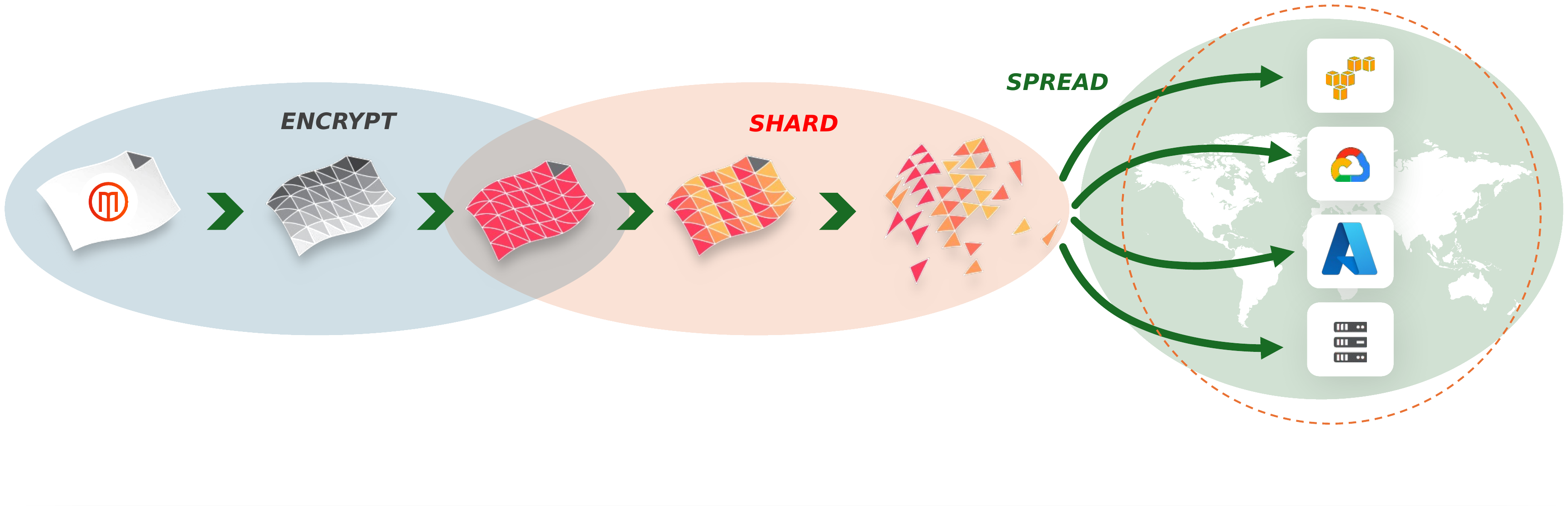
Myota's patented Shard and Spread™ technology encrypts, fragments, and distributes data across independent repositories at the moment it is written — making security intrinsic to every file.

Intrinsic security

Security encoded into the data at write time — independent of any perimeter, credential, or control that can fail or be misconfigured.

Mathematical unusability

Each shard at each location is cryptographically meaningless in isolation. The attacker cannot reconstruct anything from what they find.

Immutable by design

No privilege level can alter or delete a shard in a way that compromises the whole. Immutability is architectural, not policy-enforced.

Automatic reconstruction

Recovery requires no administrator action, no workflow, no window. The system reconstructs from surviving fragments automatically.

Continuous point-in-time

Every write point is a restore point. The concept of a backup window — and the exposure it creates — is eliminated entirely.

Storage agnostic

Runs across any mix of on-premise, cloud, and edge storage. No rip-and-replace. No single vendor dependency.

Redundancy elimination

When the data itself cannot be compromised, the copies maintained to recover from compromise are unnecessary. The cost and complexity disappears with its rationale.

If your data is whole anywhere — or can be reconstructed by anyone who reaches where your data is stored — you have a problem Myota solves.

Myota is the only architecture in the world where neither is true.

Where is your data whole — or reconstructable — today?

Every location. Every risk.

Every row below is a place your data exists in complete, readable form — or can be reconstructed by anyone who reaches it. Each one is a Myota conversation.

WHERE DATA LIVES WHOLE TODAY WHICH MEANS... WITH MYOTA...
Primary storageEvery file on every storage volume is complete and readable at rest.A ransomware process, insider, or misconfiguration can access, encrypt, or exfiltrate it.Files are fragmented at write time. Primary storage holds shards — never a complete file.
Distributed & object storageRAID, erasure coding, S3 — data is split for performance, but reconstruction is transparent to any compromised accessor.A compromised credential hands an attacker full reconstruction capability. The splitting is not a security control.Each shard independently encrypted with isolated key material. Reconstruction from the storage layer alone is impossible.
Backup repositoriesEvery backup copy is a complete, readable replica of your production data.96% of attacks target backups first — because backups are the recovery mechanism.The backup target is immune. Shards are individually inert. The recovery mechanism cannot be ransomed.
Cloud storageS3 buckets, blob storage, and object stores hold complete files by default.A misconfigured bucket or stolen credential exposes complete data immediately.Cloud storage receives shards, not files. An exposed bucket reveals fragments with no standalone value.
DR and replication sitesDR sites and replication targets hold complete copies — that is their purpose.Every additional copy is an additional target. More resilience copies = more attack surface.Reconstruction replaces replication. No complete copy at any DR location. Every write point is a restore point.
AI and data lakesTraining datasets, feature stores, and data lakes store complete records and files.Data poisoning, theft, and AI-driven errors at machine speed require data to be whole or reconstructable.Training data is fragmented at write time. Any AI-driven error rewinds to any precise second.
Edge and remote sitesRemote and edge locations store complete local copies for performance and availability.Physical theft, local ransomware, and insider threat all require complete data to be useful.Edge locations hold shards. Stolen hardware yields only inert fragments. Site failure triggers automatic reconstruction.
Regulated data (HIPAA, PCI, GDPR)Regulated records — patient data, payment data, PII — exist as complete files in compliant systems.A breach of complete records triggers mandatory disclosure, fines, and liability regardless of encryption.Regulated data is never whole at any location. Compliance is architectural. Right to erasure = shard destruction.
Misconfigured environmentsMisconfigurations — the #1 cause of cloud breaches — expose whatever data is stored at that location.Complete or reconstructable data at a misconfigured location is immediately accessible to anyone who finds it.A misconfigured Myota location exposes shards. Individually they reveal nothing. Security does not depend on configuration hygiene.

Every other vendor is selling
a better wall. Myota's posture
is that the wall will fail.

When the breach happens, there is nothing whole there to take. No event to respond to. No ransom to consider. No recovery to run.


Resiliency without redundancy.