
Security and resilience
Security in Myota Cyberstorage for Objects is part of the storage, not a layer added on top. This page explains what that means and why it matters.
Shard and Spread™
When you write an object, Myota encrypts it and then uses Shard and Spread™ to fragment the data, its metadata, and its encryption keys, and spread the fragments across independent storage locations. No single location holds a complete, readable copy.
Shard repository configuration
The storage locations that the fragments spread across are called shard repositories. An administrator configures them, and every bucket draws its fragments from the repositories that are set up.
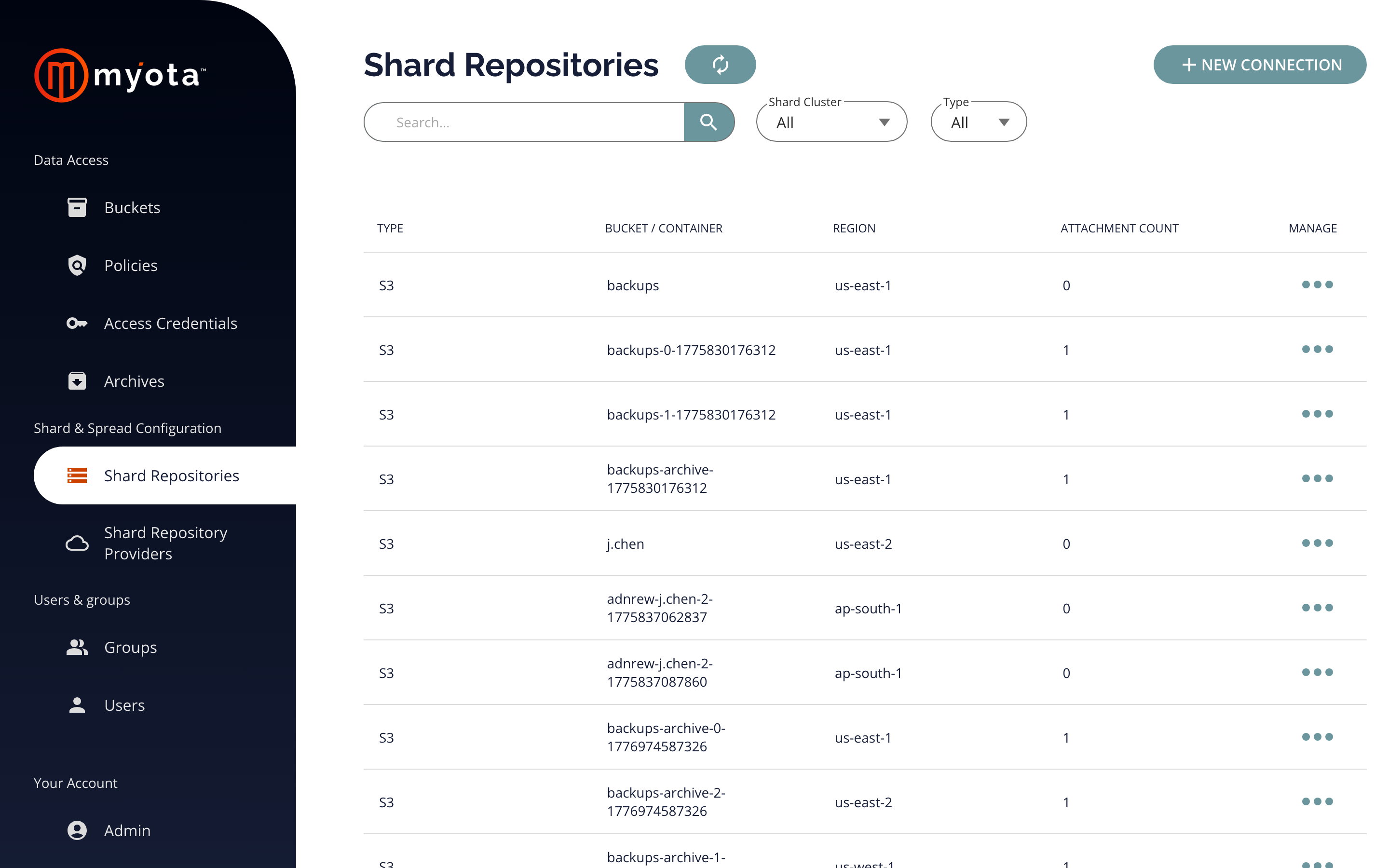
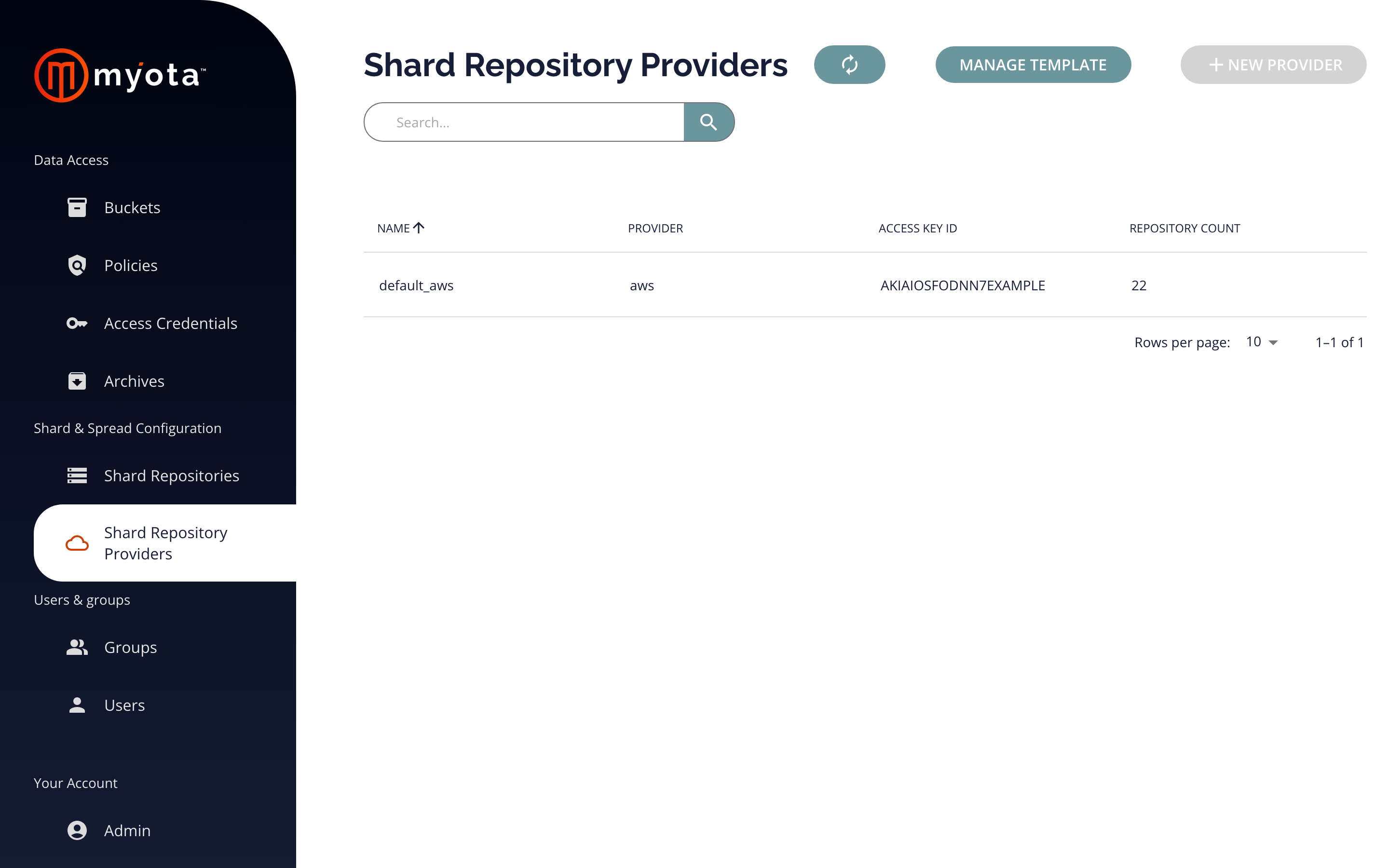
Each shard repository connects to a shard repository provider, which holds the settings for a storage provider and region. You can spread across more than one provider, so the fragments of a single object can live in different clouds. Reconstructing an object needs only a subset of its fragments, which is what gives you resilience without full copies and removes any single location that could be compromised to read the data.
Ransom immunity
Because no single location holds reconstructable data, an attacker who reaches one location cannot read your objects or hold them for ransom. Protection is intrinsic to the data from the moment it is written.
Resiliency without redundancy
Myota reassembles an object from a subset of its fragments. Your data stays recoverable even if an entire storage location is lost, without keeping full extra copies of everything. You get the durability of redundancy without paying for redundant copies.
Recover to an earlier point
With versioning, you can recover an object to an earlier version. Combined with Object Lock, this lets you roll back from accidental changes or tampering to a known-good state.
|
"Ransom immunity" refers to the protection Shard and Spread™ provides at the storage layer. It describes the storage, not a threat-detection feature. |